
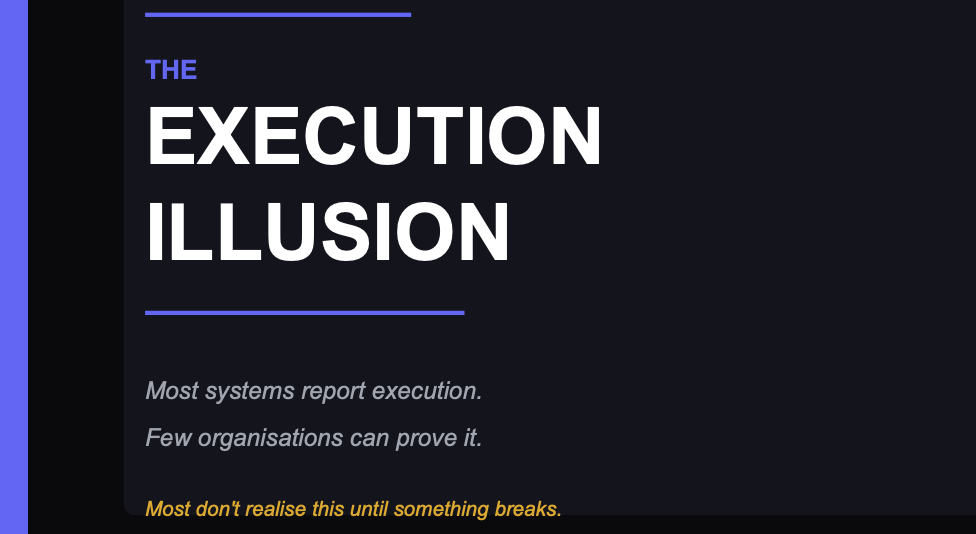
The Execution Illusion
Most systems report execution. Few organisations can prove it. What looks like progress may be something else entirely.

Why your systems say work is happening - when it isn’t
Most organisations are trying to improve performance.
Very few are asking a more fundamental question:
Is the work actually happening?
You believe your systems are working.
Why shouldn't you?
Tasks are marked complete
Dashboards show progress
Outputs are being generated
From the outside, everything looks fine.
But something feels off.
— Work takes longer than it should
— Decisions feel less certain
— People are quietly fixing things
You don’t have a performance problem.
You have a reality problem.
Download the short version (1-page PDF)
→ The Execution Illusion
Most organisations today operate on a dangerous assumption:
If a system reports execution, we assume execution happened.
This is no longer true.
A new failure mode has emerged:
Believable Non-Execution
Where:
work appears complete
systems report success
metrics look healthy
But:
outcomes don’t exist
value is not created
humans are compensating silently
The problem is not failure.
The problem is the appearance of success.
You’ve seen this.
You’ve worked around it.
You’ve probably explained it away.
- A task is “done” but needs rework
- AI output looks correct but requires heavy editing
- Teams say “it works” — but avoid relying on it
- Reports show progress — but nothing moves faster
No one escalates it.
Because:
— it technically “works”
— it doesn’t fully fail
— it’s easier to compensate than confront
And you chose not to escalate it—because it “wasn’t broken enough”.
Human Debt™
This is where the cost accumulates.
Not in systems.
In people.
Human Debt is the invisible effort required to make broken systems appear functional.
It looks like:
— manual fixes
— quiet workarounds
— double-checking outputs
— unspoken uncertainty
It is:
— unpaid
— untracked
— expected
And it grows.
It becomes part of how work gets done.
And once it does, no one questions it anymore.
Execution Debt
Over time, this becomes:
Execution Debt.
Where:
— work is reported as complete
— but execution is partial, fragile, or false
This creates:
— decisions based on incomplete reality
— optimisation of systems that don’t actually work
— compounding operational risk
You are now making decisions on work that never actually happened.
You can detect this.
But not where you’re looking.
Not in dashboards.
Not in metrics.
In behaviour.
You will recognise this immediately:
— Faster agreement, less challenge
— More output, less confidence
— Quiet corrections after “completion”
— Increasing reliance on checking, not trusting
And once you see it, you can’t unsee it.
You don’t need better metrics.
You need a different question.
Replace this:
“Is performance improving?”
With this:
Did execution actually happen?
AI didn’t create this problem.
It made it invisible at scale.
Because AI systems:
— generate outputs quickly
— appear correct
— are trusted too early
Which means:
You can scale non-execution without realising it.
You already know where this is happening.
There are parts of your organisation where:
— work is marked done, but isn’t
— systems are trusted, but shouldn’t be
— people are compensating, but not saying it
You’ve just learned to work around it.
Most organisations try to:
— improve performance
— optimise workflows
— increase adoption
Without answering the only question that matters:
Is execution real?
If you don’t verify execution:
— you cannot trust your metrics
— you cannot trust your systems
— you cannot trust your decisions
Before you optimise AI, verify execution.
Because if execution isn’t real—
neither are your results.
If this feels familiar:
→ Verify execution integrity
https://aiadoptionperformance.com
Download the short version (1-page PDF)
→ The Execution Illusion