The Crisis of Wellbeing at Work
We can all agree that the value of self-reporting, in particular when it comes to topics that are traditionally seen as taboo or mired in ill-understood and antiquated convention is at best questionable so whenever I see surveys regarding workers’ mental health, I have a tendency to dig into the...

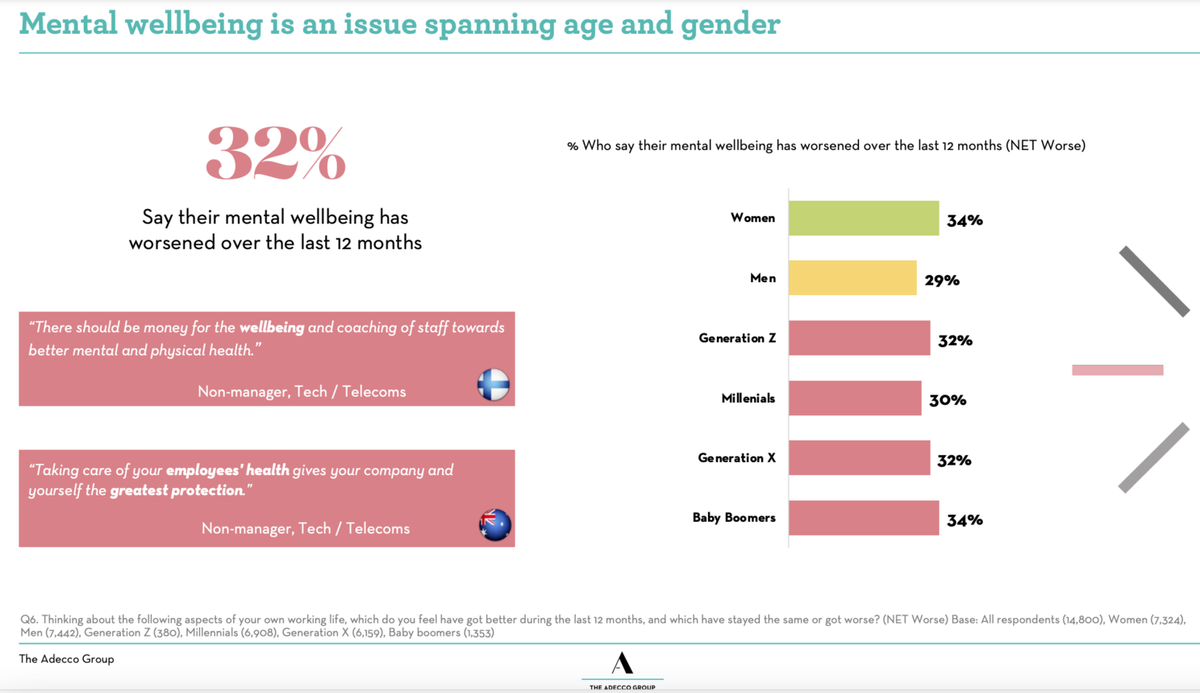
We can all agree that the value of self-reporting, in particular when it comes to topics that are traditionally seen as taboo or mired in ill-understood and antiquated convention is at best questionable so whenever I see surveys regarding workers’ mental health, I have a tendency to dig into the data to establish how big of a grain of salt needs to accompany the results. For instance, in what is otherwise a great study from Adecco, one of the results is that “1 in 3 say their mental well-being got worse in the last 12 months” but in my view, the question formulations make the data unusable as the employees were asked to agree or disagree with whether they feel they are “able to manage their mental wellbeing”. How preposterous to use that self-assessment as a point of data regarding objective mental health when we all think we are "able to manage it".
The size of the problem is infinitely more extensive than that. While people may think they can manage it, they can not. While they believe they can stay afloat they are instead avoiding diagnosing anxiety, stress and depression and only defering the consequences of this crisis of wellbeing and delaying potential catastrophic outcomes.
This meme I saw recently sums it all up, unfortunately.
Most of us -if not “all” to one extent or another- are ignoring the “check engine” light and hoping it will miraculously turn itself off if we just keep running. But make no mistake about it, we are running on empty and it won’t. While of course, the mind is adaptive and perfectly able to self-heal and improve, it can not do so accidentally, in the background or with zero acceptance or effort.
As I said many a time before, simply attempting to gloss over the pandemic’s effects on our mental well-being is not going to prove possible. We can postpone an overtly disastrous admission of generalised burnout, we can ignore the EQ crisis, we can attempt to continue in virtue of inertia without clarity on hybrid, flexibility and the new type of leadership and human work we need but all that will only take us so far and we are simply kicking the problem down the road and likely, compounding it.