Self-Improving Teams
Today’s musings are late and feverish as I’ve succumbed to the dreaded lurgy so I’ll try to keep it practical and spare you. I wanted to crowdsource some help. One of my tickets is to send an email to the amazing IT Revolution/DOES team and Gene Kim regarding the next DOES Europe and...


Today’s musings are late and feverish as I’ve succumbed to the dreaded lurgy so I’ll try to keep it practical and spare you.
I wanted to crowdsource some help. One of my tickets is to send an email to the amazing IT Revolution/DOES team and Gene Kim regarding the next DOES Europe and PeopleNotTech’s submission of a talk around “Self-Healing/ Self-Improving Teams”. In short, it will detail our journey over the past few months and how we’ve evolved from what was essentially an analysis and training tool for the team leader, to a data solutions that enables teams to work on their own Psychological Safety and therefore become more performant autonomously.
Last year at this time, our Dashboard was only visible to the team leader and it contained various tips and ideas of things they could do with their teams to better the individual components of Psychological Safety that were suffering. They were then to organise the internal help, resources or actions needed. It was also scoring the team leader on how they did Leadership, EQ and Positivity wise and it included a space for them to keep track of the interventions and interactions they would organise. It was effectively, using the data that the team had offered by answering the questions and interacting with the app to transform every team leader, no matter how technical, into a team coach or mini Counsellor Troy.
Once the pandemic hit, to help, we opened access for free to the software and we were swamped with requests and onboarded tens of teams. Very quickly it became evident that we have the wrong premise and few -if any- tech leaders needed the further headache of having to learn about their team and then do something in terms of human interventions to correct negative behaviours or encourage positive ones. Even the team leaders who fancied themselves willing, turned out to struggle and simply not have either the time or the mental capacity to do so and some reached out to HR or L&D to have them come in and use the software on their behalf. It occurred to us that we are doing no one a favour by putting the onus on the team leader and that this is a task they need help with and who better to help than the brilliant minds that will be benefiting from this?
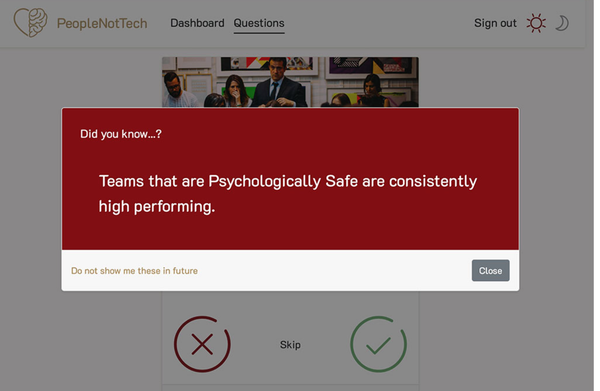
So our first step was to open access for every team member to see not only the questions they had to answer but the Dashboard whenever they liked as well. That change alone meant that when in a retro someone shared the Dashboard on the screen, they were familiar with it and able to see changes in data together. The number of times that team members accessed the dashboard was instantly very high and it showed clearly what a needed change that was. Magically, this sparked great interest in understanding how and why each category was measured on the part of the team members effectively rendering them much more engaged in offering the data by answering more questions and it also started to spark a “Now what?” dialogue.