From the FinTech Vaults (2018) Google and Payments

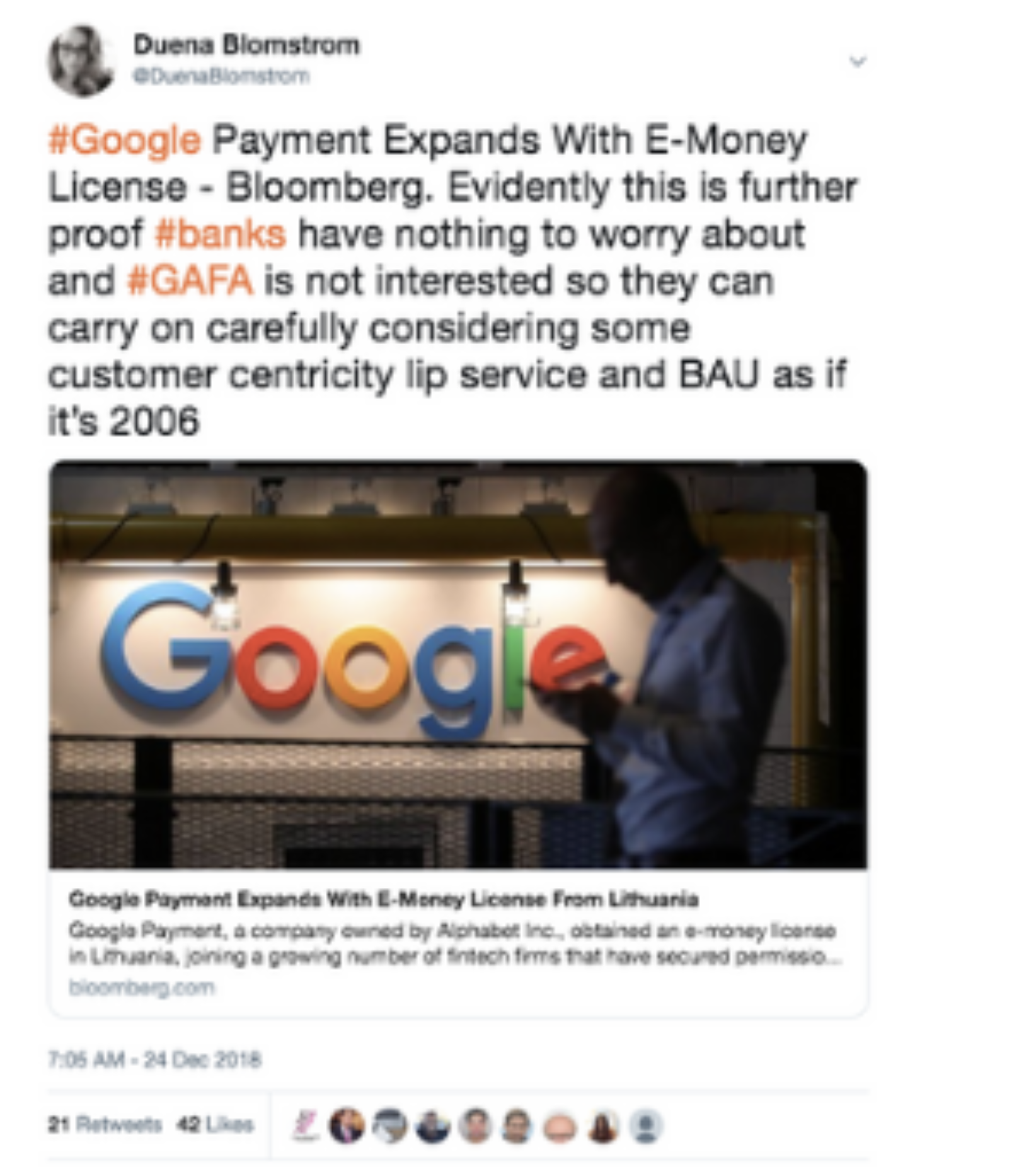
Recently, Bloomberg has reported that Google has obtained an eMoney license in Lithuania. Without any "ifs" and "but"s this reinforces Google's willingness to be a player in the Financial Services industry.
As one who has spent the last 10 years telling banks' boards that they need to be so afraid of extinction, that they ought to disrupt the way they see the consumer and technology themselves, before other players find a way to the hearts and minds of their consumers and offer them Financial Services in their place, let me tell you what immediate reactions this news has elicited in boardrooms everywhere.
None.
Ranging from mere complacency to firm paralysis, the industry is in deep denial regarding the threat of any new players taking their spot and seeing them have the same fate as the music, the photography or even the physical toys retail business.
Here are some of the things they tell themselves to feel better ranging from white lies to misinformed opinions:
"But it's only e-money"
While they have been largely simplified to attract competition in the UK and elsewhere in Europe, the process to acquire an e-money license and that of acquiring a full banking license, are still complex with the former being even more laborious for good reason. It is therefore very likely that GAFA has obtained eMoney licenses en masse first because it's easier, convenient, and it fits their initial propositions.
Thinking of the bank as a provider of products makes it seem as an illustriously big deal that the e-money providers can't offer loans or interest on balances but in effect, when you think of the endless possibilities of contextual MoneyMoments, it is only payments and transfers that offer them and those are firmly possible without a full banking license.
"But they already had one"
Someone pointed out as a response to my Tweet that Google was already e-money licensed in the UK and this is likely just a Brexit-panic response. I haven't been able to corroborate that info but even if it were so what is it proving? That banks ought to have panic-ed about it earlier? Better late than never!
"But it's only in Europe"